Philosophy. My love. My work. My on-time with coffee. My off-time with wine. Sometimes I stop to eat.
Yet, this love of mine is plagued by a reputation of exclusion. For example, the very existence of the question: Is Feminist Philosophy Philosophy? I find both perplexing and telling. Allow me to digress with a little tale.
My mother, years ago pre-Gwennie, felt ill and stayed home from work. On that day she was watching television and perked up when a list of symptoms described an ailment pertaining specifically to women’s health were discussed on a talk show. That’s what I have, she thought. According to the show, research discovered something called P.M.S. Yep, folks. No joke.
Mom immediately scheduled an appointment to see her doctor. Upon visiting the doctor she relayed what she learned and explained that it fit her illness. Nonsense, the doctor replied. There’s no such thing. He prescribed her tranquilizers and sent her home. Mom took one dose, but never any more because she said they made her feel even worse.
Today, with the advancement of medicine and knowledge regarding women’s bodies, it is difficult to picture a doctor unfamiliar with something so incredibly basic. However, women’s issues could not be identified medically if they were not studied in the first place.
And now back to my original puzzlement. Is philosophy, the pursuit of wisdom, closed in a similar fashion? Does it neglect new avenues of thought simply because it hasn’t been traditionally thought before, as the case with the doctor?
Ah..hmmm… Feminist Philosophy?
But Feminism should be in Gender Studies, I hear some cry.
Can one imagine telling the Political Philosopher that his/her study doesn’t exist because there is a Political Science Department? Or, forget Philosophy of Mind and take a walk over to the Psychology Department?
Despite this question of Feminist Philosophy and its proper academic place, for I only use it as an example of exclusion, I believe the majority of philosophers were gobsmacked at Salon’s damning headline Philosophy has a Sexual Harassment Problem and that it is not only the oldest of the humanities but “the malest and whitest.”
As a female student in undergraduate, I sensed this truth, but at the same time I found the literature so completely enthralling that gender hierarchy took a back seat in my mind. The only glaringly obvious moments were in my Philosophy of Mind course where I was the one woman in class out of about forty students, and graduation day when I was the only woman in the department to walk. Other than those moments I happily threw myself into my studies. Socrates awesome. Descartes awesome. Spinoza awesome. You get the point.
Not until midway into my Master’s Degree did I think to ask “Are there any women philosophers?” My thesis supervisor handed me the book On Violence by Hannah Arendt. I dropped everything, read all of her books, and anything about her I could get my hands on. She became my obsession. Arendt was not a feminist thinker, but that was not really what I was looking for. Quite simply, I just wanted to know that there was such a thing as a woman philosopher.
Two years later during the summer holiday I planted myself at a cafe and read the novel All Men Are Mortal by Simone de Beauvoir. Stop the presses! I ensconced myself in Beauvoir’s works, existentialism in general, and completely reoriented my Ph.D. dissertation. Even in the midst of my giddiness over this new found love, I knew that this came about because I sought it, and not because women thinkers appeared on any of my course syllabi. There I was, approximately 5 years into my study of philosophy and I had never been to a university lecture on a woman philosopher.
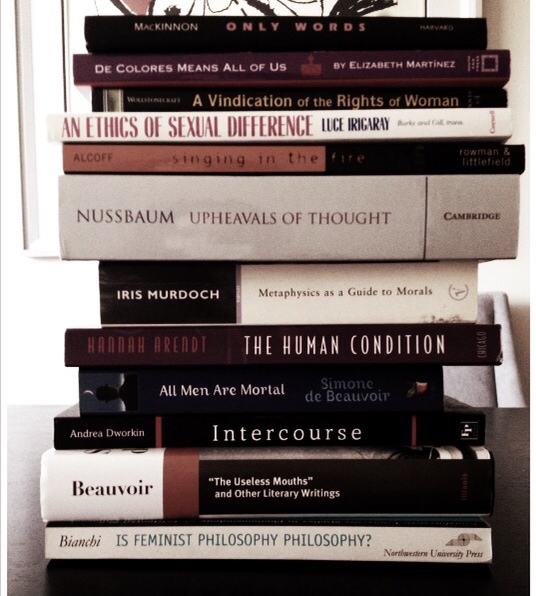
I’d like to suggest a meaningful way to make philosophy a more inclusive pursuit, namely, professors should examine their syllabi and required course reading material.
How are we, in higher education, presenting philosophy to the next generation? Are we, through the syllabus, implying to women and minority students, albeit by omission, that the only contributors to theory are white men? Are philosophers perpetuating the disgraceful status of “malest and whitest”? Are we challenging ourselves to read and research outside of our academic comfort zone?


Leave a Reply